Want to get the most benefit from your GLP-1? Save 66% on our strength training guide!
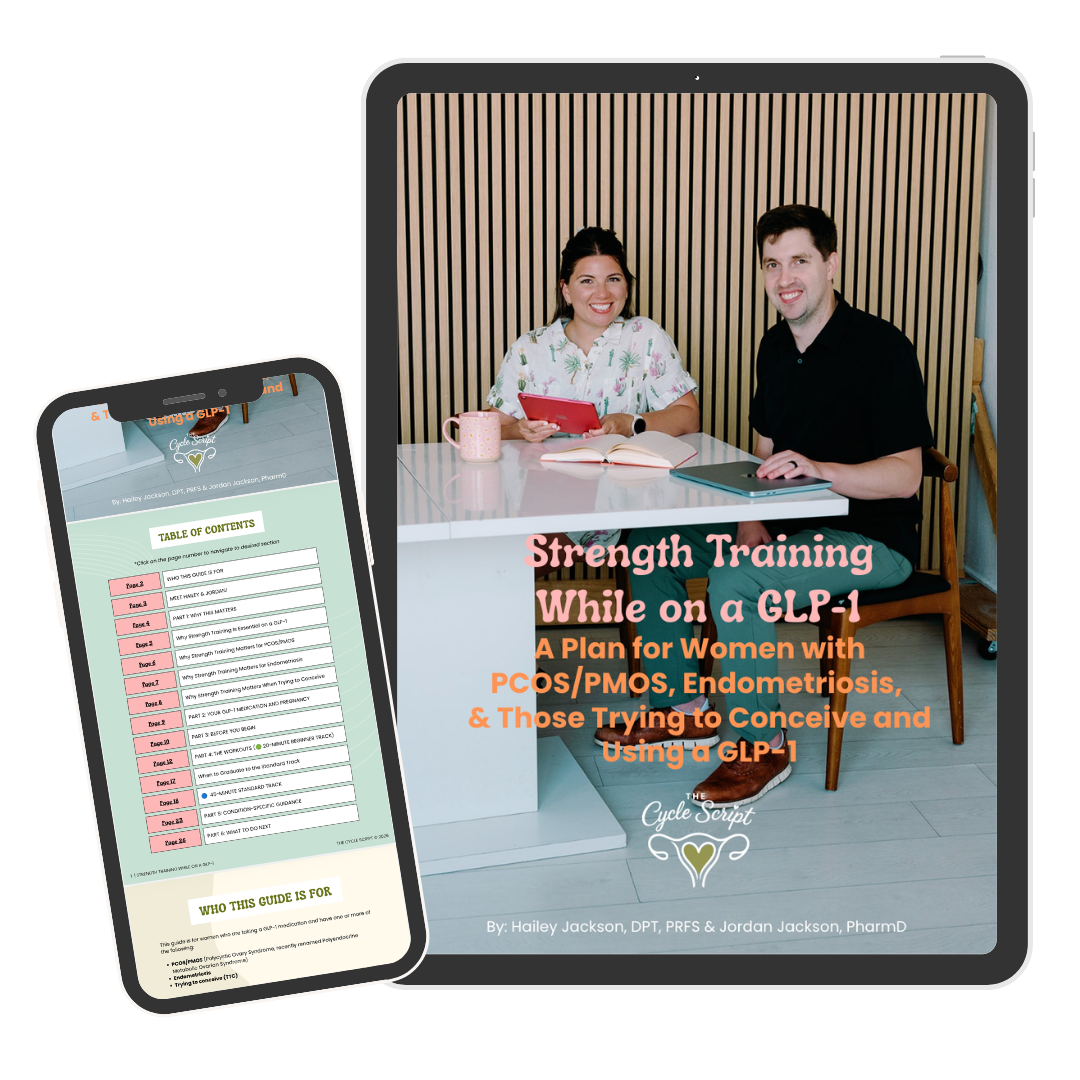
Strength Training While on a GLP-1: A Guide for Women with PCOS/PMOS, Endometriosis, & Those Trying to Conceive and Using a GLP-1
You’re taking a GLP-1…
Now here's the program that not only helps you manage your PCOS or endometriosis symptoms, but is also the secret sauce to help your GLP-1 work long term:
Strength Training While on a GLP-1:
The Complete 12-Week Home Workout Program for Women with PCOS/PMOS, Endometriosis, and Those Trying to Conceive
Originally $45
Only $15
Your GLP-1 is working, but it’s likely taking your muscle with it.
Up to 40% of the weight you lose on a GLP-1 medication can come from muscle, not fat.
That means:
Your metabolism slows down, making it harder to keep the weight off
Insulin resistance can actually get worse, the opposite of what you need with PCOS/PMOS
Your bones weaken during rapid weight loss
If you stop the medication, the weight you regain comes back as fat, not muscle
Strength training is the only proven way to fix this. Research shows it can reduce muscle loss by up to 95% during weight loss, and a joint advisory from four major medical organizations now recommends that every woman on a GLP-1 should be strength training at least 3 times per week.
But here's the problem: most strength training programs aren't designed for you. They don't account for your PCOS/PMOS symptoms, your endometriosis flares, your fertility goals, or the fact that your GLP-1 has cut your appetite in half.
This one does.
If you have PCOS/PMOS:
Strength training has been shown to reduce testosterone levels, lower AMH, improve insulin sensitivity, and restore menstrual regularity. A 20-week exercise program improved ovulation rates by 49%. HIIT was 7.8x more likely to improve menstrual cyclicity than steady-state cardio. The 2023 International PCOS Guideline recommends muscle-strengthening exercises at least 2 days per week — and GLP-1 medications are now recommended alongside active lifestyle intervention for weight management in PCOS/PMOS.
If you have endometriosis:
A clinical trial found that a 9-week program combining resistance exercises with lumbopelvic stabilization produced large improvements in quality of life — sustained at 1 year — along with reduced pain during sex, increased core strength, and higher pain thresholds. Exercise reduces the inflammatory markers (TNF-α, NF-κB) that drive endometriosis. This program includes a flare-day plan and a 20-minute beginner option designed specifically for days when fatigue and pain are high.
If you're trying to conceive:
Women who exercise have more than double the pregnancy rate and more than double the live birth rate compared to non-exercising controls. Vigorous activity is associated with 69% higher fecundability. Among overweight and obese women, even walking was linked to 82% higher fecundability. But there's a sweet spot: 30–60 minutes per day supports fertility, while more than 60 minutes may increase the risk of not ovulating. This program keeps you in that window.
Everything you need to get started on your strength training journey:
Two complete 12-week programs — choose the one that fits your life:
🟢 20-Minute Beginner Track — bodyweight + resistance bands only. Perfect if you're new to strength training, adjusting to GLP-1 side effects, or managing endo flares. 3 days/week, 20 minutes each.
🔵 45-Minute Standard Track — dumbbells + bands. For women ready for more volume. 3 days/week, 45–60 minutes each.
100% home-friendly — no gym, no barbells, no machines. Just bands, dumbbells, and a sturdy chair.
3 progressive phases in each track (Foundation → Building → Strength) so you never plateau
36 total workouts laid out in easy-to-follow tables with exercises, sets, reps, and equipment
Condition-specific guidance — tailored advice sections for PCOS/PMOS, endometriosis, and TTC
GLP-1 nutrition guide — how to hit your protein targets when your appetite is gone (hint: 1.2–1.6 g/kg/day, protein first at every meal)
GLP-1 + pregnancy safety section — when to stop your medication, what to expect, and how to maintain your progress
Flare-day modifications for endometriosis — because some days, 20 minutes of gentle movement is a win
Research-backed throughout — every recommendation is grounded in clinical evidence
This program was built for you if…
You're on Wegovy, Ozempic, Zepbound, Mounjaro, or Saxenda
You have PCOS/PMOS and want to improve your insulin resistance, lower your androgens, and regulate your cycle
You have endometriosis and need a program that respects your pain and energy levels
You're trying to conceive and want to optimize your fertility naturally
You've never strength trained before (or it's been a while)
You want to work out at home with minimal equipment
You're tired of generic fitness programs that don't understand your body
What’s inside?
Basically everything you need to optimize your strength training journey:
✅ Two complete 12-week programs — choose the one that fits your life:
🟢 20-Minute Beginner Track — bodyweight + resistance bands only. Perfect if you're new to strength training, adjusting to GLP-1 side effects, or managing endo flares. 3 days/week, 20 minutes each.
🔵 45-Minute Standard Track — dumbbells + bands. For women ready for more volume. 3 days/week, 45–60 minutes each.
✅ 100% home-friendly — no gym, no barbells, no machines. Just bands, dumbbells, and a sturdy chair.
✅ 3 progressive phases in each track (Foundation → Building → Strength) so you never plateau
✅ 36 total workouts laid out in easy-to-follow tables with exercises, sets, reps, and equipment
✅ Condition-specific guidance — tailored advice sections for PCOS/PMOS, endometriosis, and TTC
✅ GLP-1 nutrition guide — how to hit your protein targets when your appetite is gone (hint: 1.2–1.6 g/kg/day, protein first at every meal)
✅ GLP-1 + pregnancy safety section — when to stop your medication, what to expect, and how to maintain your progress
✅ Flare-day modifications for endometriosis — because some days, 20 minutes of gentle movement is a win
✅ Research-backed throughout — every recommendation is grounded in clinical evidence
Get the full program today at a special rate.
$45 Originally
$15 Now
Want more than a workout program?
If you're looking for specific, actionable help for symptoms related to PCOS/PMOS, endometriosis, or fertility, Jordan and I would love to work with you.
We recommend starting with this strength training program and building a routine around it… it's one of the main pillars of what we do. But we also offer:
Supplementation recommendations tailored to your condition
Medication review to make sure everything is working together
Nutrition recommendations designed for your goals and your GLP-1
Lifestyle modifications including sleep strategies, stress management, and more
If you're interested in working with us, you can find out more information and enroll here: